

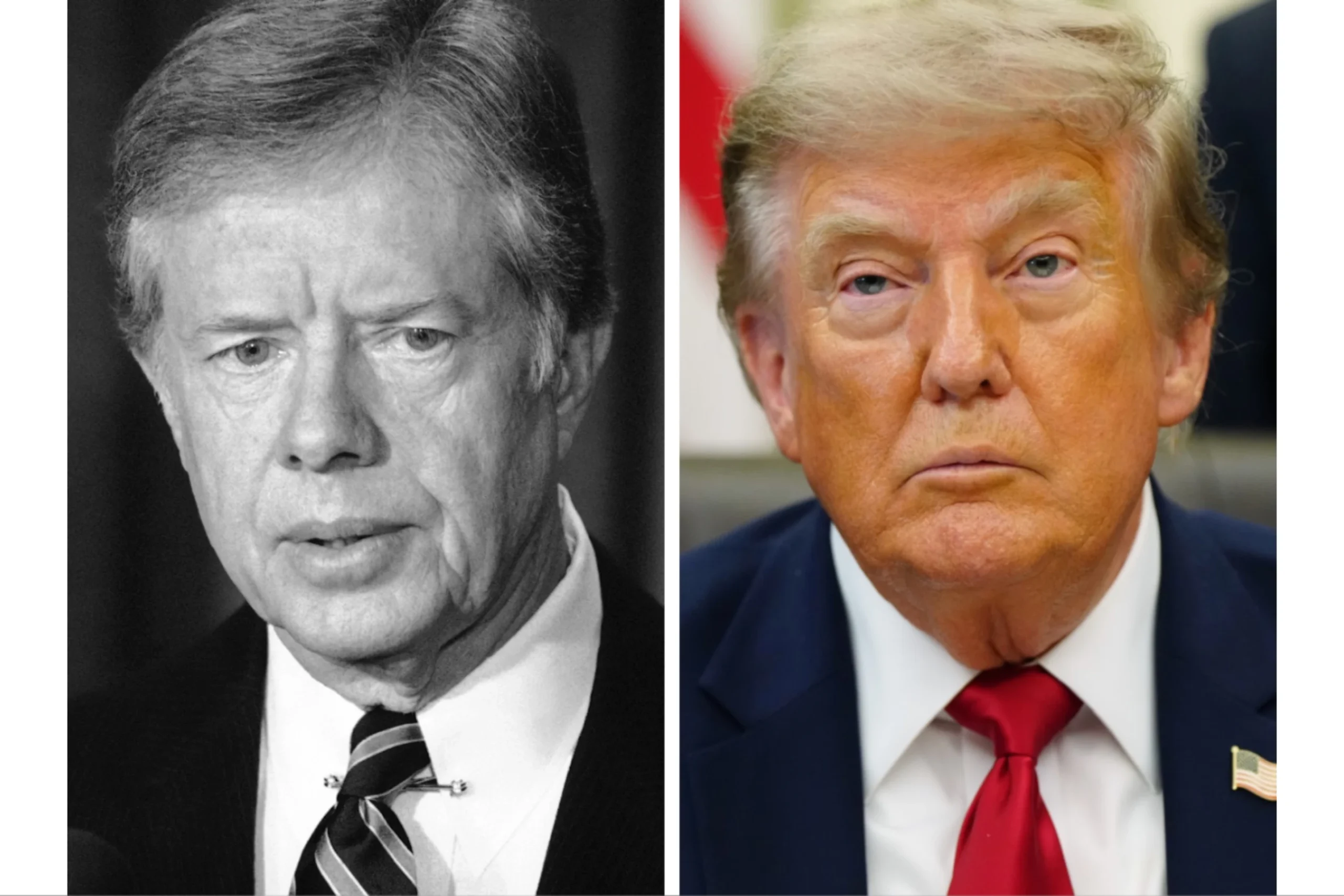
U.S. President Donald Trump is increasingly drawing comparisons to former President Jimmy Carter as his administration grapples with a prolonged conflict with Iran and persistent inflation—two defining challenges that also marked Carter’s presidency more than four decades ago.
While Trump frequently used Carter as a political target during previous campaigns, analysts say the president’s recent remarks suggest a more reflective tone as his administration confronts similar geopolitical and economic pressures.
Speaking last month about military options against Iran, Trump said he did not want to “feel like being Jimmy Carter,” referencing the failed 1980 U.S. rescue mission to free American hostages in Tehran, an operation that ended with the deaths of eight U.S. servicemen and became a defining moment of Carter’s presidency.
The comment comes as the United States remains deeply involved in military operations linked to the conflict with Iran, including efforts to secure the strategically important Strait of Hormuz following renewed hostilities.
Inflation has also emerged as a major challenge for Trump’s administration. Although current inflation levels remain well below the record highs experienced during Carter’s presidency, rising consumer prices continue to weigh on the U.S. economy despite Trump’s long-standing promises to reduce costs.
White House spokesperson Olivia Wales dismissed comparisons between the two presidents, saying Trump remains focused on preventing Iran from acquiring nuclear weapons and implementing economic policies aimed at lowering costs for Americans.
“The president is a one-of-a-kind leader who will always unapologetically advance America’s interests,” Wales said, adding that Trump’s priority is strengthening the country rather than focusing on his historical legacy.
Political historians, however, argue that similarities between the two administrations have become increasingly difficult to ignore.
Jonathan Alter, author of a biography on Carter, said the growing comparisons reflect the reality that Trump is confronting challenges that could shape his presidential legacy in ways similar to Carter’s.
Despite those parallels, analysts note major differences between the two leaders. Carter, who served from 1977 to 1981, was widely known for emphasizing ethics in government, placing his family’s business in a blind trust and later receiving the Nobel Peace Prize for his humanitarian work.
Trump, by contrast, has continued to maintain business interests through family-run enterprises while remaining an outspoken and polarizing political figure.
Foreign policy experts also point to similarities in how both administrations have dealt with Iran and the strategic importance of the Strait of Hormuz, a vital shipping route for global energy supplies.
During Carter’s presidency, officials considered military action against Iran’s Kharg Island but ultimately decided against it to avoid escalating the conflict. Under Trump, U.S. forces have already targeted the island as part of military operations aimed at disrupting Iranian oil exports.
Analysts say Iran’s response to the ongoing conflict and its potential political consequences could influence U.S. domestic politics ahead of the upcoming midterm elections.
Trump has also increasingly invoked the legacy of past American presidents, frequently referencing leaders including William McKinley, Theodore Roosevelt, Franklin D. Roosevelt and Herbert Hoover while discussing his administration’s policies and long-term vision.
Political observers say the renewed focus on presidential history reflects Trump’s growing interest in how his time in office will ultimately be judged alongside those who preceded him.