

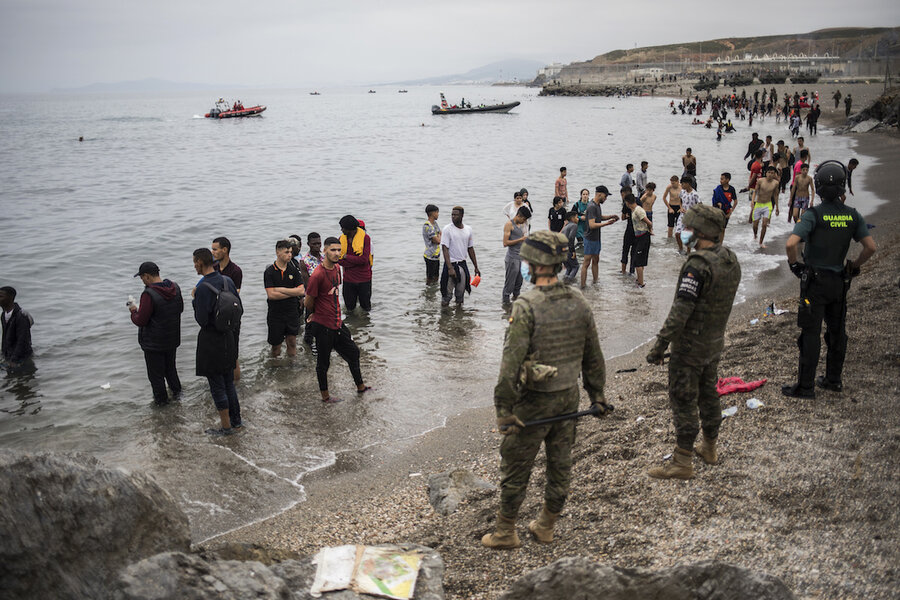
Spain and Morocco have reinforced security along the border of the Spanish enclave of Ceuta after tens of thousands of people crossed into the territory by land and sea in a single day, triggering a major humanitarian and security emergency.
Spanish authorities said the increased security presence appeared to have largely halted the mass movement after more than 49,000 migrants entered Ceuta, a Spanish territory on the northern tip of Africa.
Spanish Prime Minister Pedro Sánchez, visiting the enclave, criticised the sudden influx and described it as a violation of Spain’s territorial integrity.
“The Spanish government stands with the city of Ceuta,” Sánchez said, acknowledging the anxiety and concern among residents and authorities.
Footage from the area showed large numbers of people attempting to reach Ceuta by swimming around coastal barriers or climbing over the border fence separating Spain from Morocco.
Spanish military units were deployed after local authorities appealed to Madrid for assistance in restoring order. Officials said at least 34 people had died, with some reported to have drowned while others were killed in a stampede near the Tarajal beach border area.
The crisis left thousands of migrants, including unaccompanied children, stranded across the enclave, with many sleeping in parks, on pavements and in other public areas after reception facilities became overwhelmed.
A local association representing Civil Guard officers described the situation as a serious humanitarian crisis, warning that authorities were struggling to manage the sudden arrival of such large numbers of people.
Among those searching for missing relatives was Moroccan agricultural worker Ikraa Khai, who travelled to the beach looking for her nephew.
“I don’t know if he is dead or alive. I have his residency card. But I don’t know where he is, I’m searching,” she said.
The authorities have not immediately established what triggered the unprecedented movement of people toward the enclave.
Ceuta is one of Spain’s two North African territories and has long served as a significant migration route for people seeking entry into Europe, particularly those fleeing conflict, poverty and political instability.
Ceuta regional president Juan Jesús Vivas had warned that the territory’s migrant reception facilities were already overwhelmed, with hundreds of people sleeping on the streets before the latest influx.
The enclave has been under Spanish control since 1580 and is home to a mixed population of Spanish and Moroccan residents, including Christian and Muslim communities.
The latest crisis has renewed pressure on Spain and Morocco to strengthen border management while addressing the humanitarian conditions facing migrants attempting to enter Europe.