

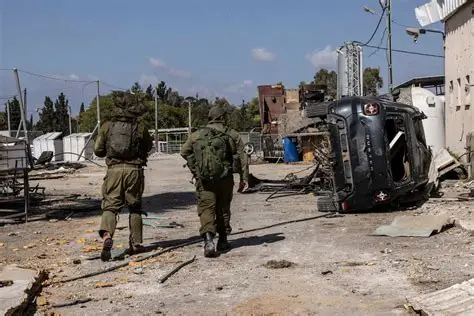
Israel has publicly acknowledged the existence of a specialized intelligence operation established to identify and pursue people it says were involved in the October 7, 2023 Hamas-led attack, the killing and abduction of Israelis, and the subsequent holding or abuse of hostages.
The operation, known as NILI, is a joint initiative involving the Israel Defense Forces (IDF) and Shin Bet, Israel’s domestic security agency. Israeli officials have described its mission as identifying participants in the October 7 attack and locating those who were involved in planning, carrying out or facilitating the assault.
The name NILI is derived from the Hebrew phrase Netzach Yisrael Lo Yishaker, commonly translated as “The Eternal One of Israel will not lie.”
According to Israeli reporting published in August 2026, the operation had compiled a database containing thousands of names. Investigators reportedly used photographs and videos recorded during the October 7 assault, facial-recognition technology, artificial intelligence, interrogations of detainees and human intelligence to identify suspected participants.
About 2,800 people on NILI list reported killed
The Times of Israel, citing a Channel 12 report and Israeli security officials, reported that approximately 2,800 people on the NILI list had been killed as of August 2026.
The figure includes approximately 1,200 attackers who were killed during the October 7 assault itself, meaning the total does not represent people subsequently killed solely as a result of NILI operations. Israeli officials have said the list covers people identified as having participated in the invasion, assisted the attack or been involved in holding hostages.
Israeli media have previously reported different figures as the investigation continued. The number of identified and confirmed casualties has therefore changed over time.
The operation is reportedly continuing, with Israeli security officials indicating that the identification process remains active.
Senior Hamas figures among those killed
The campaign has coincided with the deaths of several senior Hamas figures.
Among them was Yahya Sinwar, who was killed by Israeli forces in Gaza in October 2024 after a prolonged Israeli search. Hamas subsequently confirmed his death.
Hamas also confirmed in January 2025 the deaths of senior military commanders Mohammed Deif and Marwan Issa, both of whom Israel had targeted during the war.
Mohammed Sinwar, Yahya Sinwar’s brother and Hamas’ military chief in Gaza, was also confirmed dead by Hamas in August 2025, months after Israel said it had killed him in a strike.
Hamas political chief Ismail Haniyeh was killed in Tehran in July 2024. Iran and Hamas blamed Israel at the time, although Israel initially did not publicly acknowledge responsibility. In December 2024, then-Israeli Defence Minister Israel Katz publicly acknowledged Israel’s role in Haniyeh’s killing.
Hamas deputy chief Saleh al-Arouri was killed in a January 2024 strike in Beirut that was widely attributed to Israel.
Hezbollah leadership also targeted
Israel’s campaign has extended beyond Hamas to Hezbollah commanders in Lebanon.
Among those killed were Hezbollah leader Hassan Nasrallah, senior commander Fuad Shukr, operations commander Ibrahim Aqil, missile commander Ibrahim Qubaisi, southern-front commander Ali Karaki, and commanders Taleb Abdallah and Mohammed Nasser.
Hashem Safieddine, who had been widely regarded as a potential successor to Nasrallah, was also killed in an Israeli strike in Beirut in October 2024. Hezbollah later confirmed his death.
The killings significantly affected Hezbollah’s senior command structure and became part of Israel’s broader campaign against the Iran-backed group following the outbreak of hostilities after October 7.
Senior Iranian commanders killed
Israel’s military campaign has also included senior Iranian military figures.
In June 2025, Israeli strikes on Iran killed several senior commanders, including IRGC Commander-in-Chief Hossein Salami, Armed Forces Chief of Staff Mohammad Bagheri, Aerospace Force commander Amir Ali Hajizadeh and IRGC commander Gholamali Rashid, according to Reuters reporting.
The campaign escalated further in 2026. Iran’s Supreme Leader Ayatollah Ali Khamenei was killed on February 28, 2026, in the opening strikes of the U.S.-Israeli war against Iran, according to Reuters. His death was subsequently followed by a state funeral in Iran in July.
A long-term intelligence campaign
The NILI operation represents a broader effort by Israeli security agencies to build individual profiles of people suspected of participating in the October 7 attack.
Rather than relying solely on battlefield intelligence, the operation reportedly draws on digital evidence, photographs, video footage, facial recognition, interrogations and human sources to establish identities and connections.
The October 7 attack killed approximately 1,200 people in Israel and resulted in about 250 people being taken hostage, according to Israeli tallies. The assault triggered the war in Gaza and a wider regional confrontation involving Hamas, Hezbollah, Iran and other armed groups.
Israeli officials have repeatedly said that those responsible for the attack would continue to be pursued even years after the original assault.
The disclosure of NILI in August 2026 provided the clearest public account yet of how Israel has organized that effort and the scale of the database built around the October 7 attack.
For Israel, the operation is not limited to the senior leadership of Hamas or Hezbollah. According to Israeli security officials, the objective is also to identify individual participants and others believed to have assisted in the attack, abductions and captivity of hostages.
The operation therefore remains ongoing, with Israeli authorities continuing to identify, locate and target people they say were involved in the October 7 attacks and related hostage operations.