

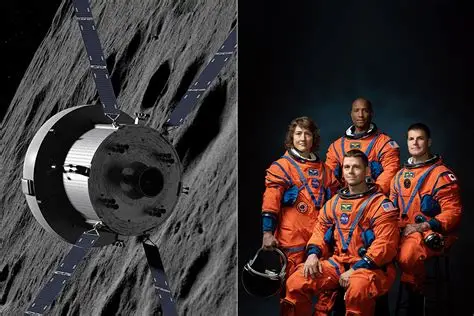
Astronauts aboard Orion spacecraft are now more than halfway to the moon as part of the historic Artemis II, marking humanity’s first crewed journey toward the lunar surface in more than five decades.
The four-member crew — Americans Victor Glover, Reid Wiseman, Christina Koch, and Canadian astronaut Jeremy Hansen — are expected to reach the moon on Monday, when they will conduct a fly-around and photograph the lunar far side before returning to Earth.
The mission, operated by NASA, is the first crewed lunar journey since the final Apollo 17 mission in 1972 and is designed to test systems for future lunar landings.
As the spacecraft travels deeper into space, pilot Victor Glover reported that the moon is rapidly growing larger in view, signaling the crew’s steady progress toward their destination.
However, the journey has not been without minor technical challenges. Engineers are working to resolve issues with the capsule’s toilet system, which malfunctioned shortly after liftoff. Mission Control has advised the crew to rely on backup urine collection bags until the issue is fully resolved.
NASA engineers believe ice may be blocking part of the system responsible for flushing waste overboard. Despite the inconvenience, officials say the astronauts remain safe and well prepared to manage the situation.
The Artemis II crew is expected to travel more than 252,000 miles (about 400,000 kilometers) from Earth before looping behind the moon and returning home a distance record that will surpass that set during the Apollo 13 mission.
The flight also marks several historic milestones. Christina Koch becomes the first woman to travel toward the moon, while Victor Glover is the first Black astronaut on a lunar mission. Jeremy Hansen’s participation makes him the first non-American to fly toward the moon.
The nearly 10-day mission is scheduled to conclude with a splashdown in the Pacific Ocean on April 10. Artemis II is seen as a critical step in NASA’s long-term plan to establish a sustainable human presence on the moon, including a targeted crewed landing near the lunar south pole by 2028.