

A quarter-century after the Holocaust nearly destroyed the cultural world of European Yiddish-speaking Jews, the language and traditions are experiencing a renewed revival in the German city of Weimar.
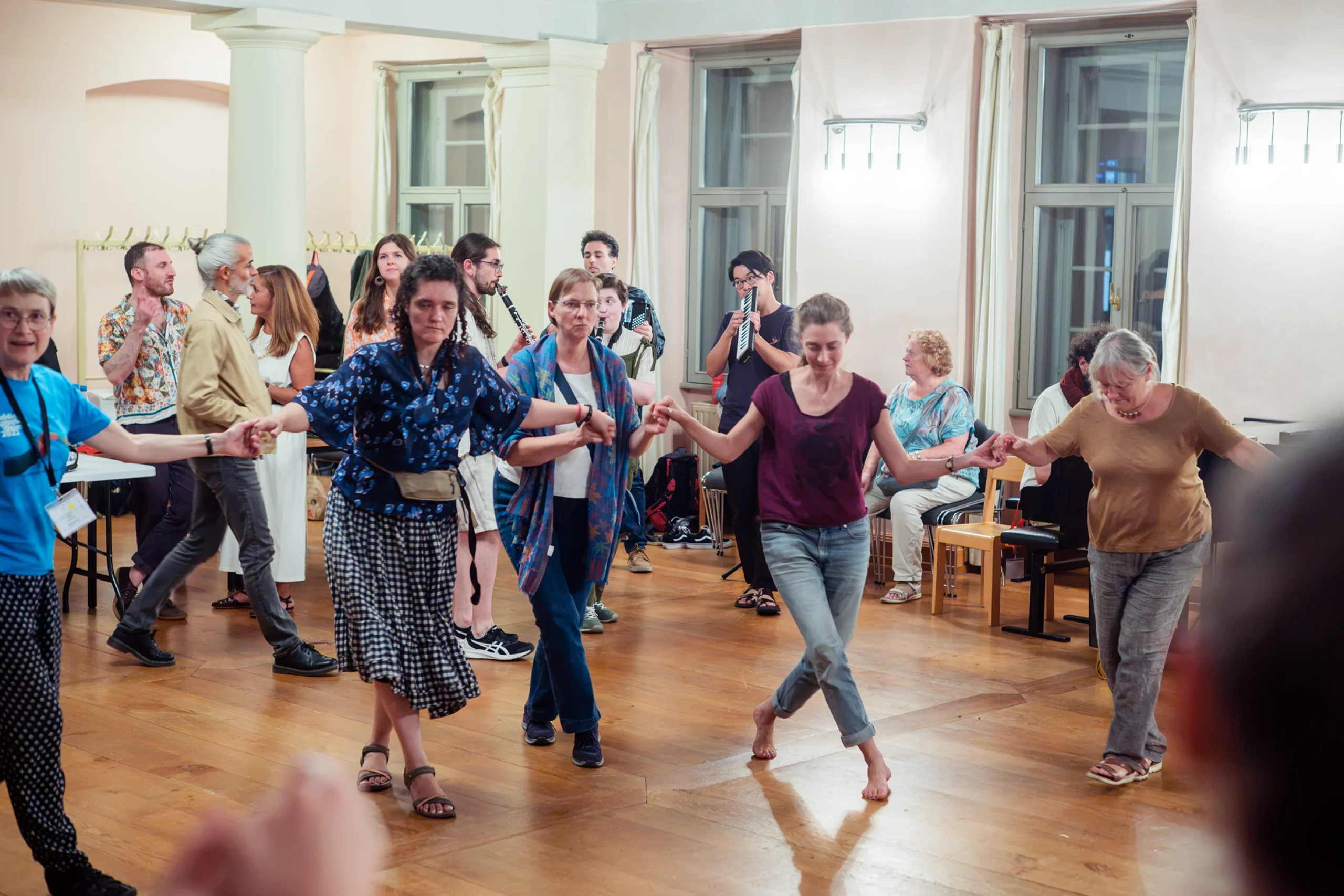
The annual Yiddish Summer Weimar festival has transformed the city into a major international center for Yiddish music, language and cultural exchange, bringing together hundreds of musicians, students and scholars for workshops, concerts and performances.
Founded in 1998, the program has grown from a small weekend workshop into one of Europe’s largest festivals dedicated to Yiddish culture.
This year’s program ran from July 11 to August 15, with the main festival week taking place from August 8 to 15.
From a language of millions to a cultural revival
Before the Second World War, Yiddish was spoken by more than 11 million people worldwide and was the principal language of the majority of European Jews.
The language developed over centuries among Ashkenazi Jewish communities, beginning in the Rhineland before spreading eastward into territories including Poland, Lithuania, Ukraine and Hungary, and eventually to North America.
Yiddish is closely related to German but incorporates substantial Hebrew and Aramaic vocabulary alongside Slavic and other linguistic influences.
The Holocaust devastated the communities that had sustained the language and its cultural traditions across Europe.
For Alan Bern, founder and artistic director of Yiddish Summer Weimar, the festival was established in part to challenge the perception that Yiddish culture belongs only to the past.
“From the beginning, the idea was to present Yiddish culture as something which is alive, and not something that was entirely destroyed by the Shoah,” Bern said.
The festival now attracts participants from Jewish and non-Jewish backgrounds, with Bern estimating that at least half of its participants are not Jewish.
Yiddish enters a new generation
The revival extends beyond Germany.
Yiddish remains widely spoken in growing ultra-Orthodox Jewish communities, particularly in the United States and Israel, where demand has helped sustain Yiddish publishing, music and contemporary media.
Teachers at the Weimar programme say the language is also attracting younger secular Jews searching for new ways to explore their heritage and identity.
Eidel Malowicki, a Yiddish teacher who grew up in a Hasidic family in Vienna, said contemporary Yiddish culture is expanding through music, magazines, comics and other forms of popular culture.
The growth has also reached digital education. According to figures cited by Religion News Service, language-learning platform Duolingo had nearly 300,000 users enrolled in its Yiddish course in 2026, with most users under the age of 25.
Academic and cultural programs dedicated to Yiddish have likewise expanded internationally, with more than two dozen summer programs, camps and festivals reported during 2026.
A bridge between cultures
Yiddish Summer Weimar has deliberately positioned itself as more than a celebration of Jewish heritage.
Organizers describe the program as a transcultural and transnational project, bringing together musicians and students from different backgrounds to explore connections between Yiddish culture and other European and Mediterranean traditions.
The festival has previously worked with youth orchestras from Poland and France. This year, the Yam Ensemble brought together young musicians from Germany, Greece and Turkey to explore connections between Mediterranean and Klezmer music.
Participants say the experience offers an opportunity to discover aspects of European history that were largely erased from public consciousness following the Holocaust.
Michael Panzner, an intercultural consultant from Frankfurt, said learning about Yiddish culture had helped him explore a part of German and European history that he had previously known little about.
For others, the language has become a way to examine Jewish identity from perspectives extending beyond contemporary political narratives.
Dan Kedem, who travelled from the Tel Aviv area to volunteer at the festival, described Yiddish as a way of exploring Jewish identity through a broader cultural lens.
Weimar’s complicated history
The choice of Weimar as the festival’s home carries a powerful historical contrast.
The city is internationally associated with figures including Johann Wolfgang von Goethe and Friedrich Schiller, as well as the Bauhaus movement and composer Franz Liszt.
It is also closely connected with Germany’s descent into fascism.
The Nazi Party strengthened its presence in Weimar and the surrounding Thuringia region during the 1920s and 1930s. The region remains an important base for Germany’s far-right Alternative für Deutschland party.
Bern said the contrast is striking: a city associated with Germany’s cultural heritage now hosts a major celebration of the Jewish culture that the Nazi regime attempted to destroy.
For festival organizers, however, the contradiction makes Weimar particularly appropriate.
Andreas Schmitges, the festival’s curator, said Yiddish culture belongs alongside the city’s better-known European artistic traditions.
He argued that while Weimar is celebrated for its German “high culture”, Yiddish culture should also be recognized as one of Europe’s major cultural traditions.
Culture survives through reinvention
The festival’s organizers say the goal is not simply to preserve Yiddish as a historical artefact but to encourage its continued development.
From contemporary music and literature to language education and international collaboration, Yiddish is being presented as a living culture capable of adapting to new generations and new communities.
That approach reflects the central philosophy behind Yiddish Summer Weimar: remembering the destruction of Europe’s Yiddish-speaking world while demonstrating that its cultural traditions survived and continue to evolve.
In a city carrying both the legacy of European cultural achievement and the painful history of German fascism, the festival has become a platform for cultural renewal, historical reflection and international exchange.