

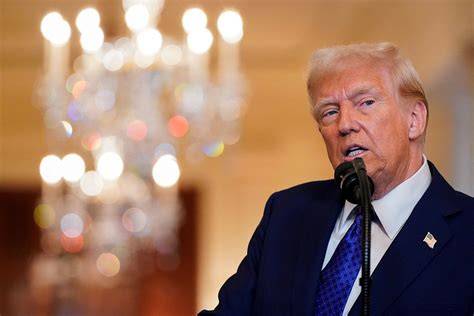
United States President Donald Trump has linked his increasingly aggressive posture on Greenland to his failure to receive the Nobel Peace Prize, telling Norway’s prime minister that he no longer felt “an obligation to think purely of peace,” according to two European officials familiar with the exchange.
The message, sent to Norwegian Prime Minister Jonas Gahr Støre, has heightened tensions between Washington and its European allies as Trump presses claims over Greenland, a self-governing territory within the Kingdom of Denmark and a member of NATO through Denmark.
Trump’s remarks come amid a broader standoff triggered by his threats to impose U.S. control over Greenland. In a bid to pressure European governments that have rallied behind Denmark and Greenland, Trump announced over the weekend a 10 percent import tariff on goods from eight European countries, including Norway, set to take effect in February.
European leaders issued sharp rebukes, warning that the move risks escalating into a trade conflict. However, British Prime Minister Keir Starmer sought to calm tensions on Monday, saying he believed the dispute could be resolved through dialogue and that he did not expect military action over the Arctic island.
“I think this can be resolved and should be resolved through calm discussion,” Starmer said, while cautioning that a trade war would benefit no one.
Message to Oslo
According to the officials, Trump’s message to Støre explicitly referenced the Nobel Peace Prize, which is awarded by an independent Norwegian committee. In the text, Trump suggested that Norway’s failure to award him the prize freed him from prioritizing peace considerations and asserted that global security required “complete and total control of Greenland.”
The message was reportedly circulated among several European ambassadors in Washington. Støre confirmed receiving a text from Trump but declined to disclose its contents, noting that the Nobel Peace Prize is decided by an independent committee and not by the Norwegian government.
“Norway’s position on Greenland is clear,” Støre said. “Greenland is part of the Kingdom of Denmark, and Norway fully supports Denmark on this matter.”
He added that dialogue remained preferable and expressed hope for discussions with Trump during the World Economic Forum in Davos later this week.
Protests and regional reaction
The escalation has sparked public reaction in Greenland itself. Over the weekend, thousands of residents marched to protest any attempt to place the island under U.S. control. Greenland’s Prime Minister Jens-Frederik Nielsen said tariff threats would not alter the territory’s stance.
“We will not be pressured,” Nielsen wrote in a social media post. “We stand firm on dialogue, respect, and international law.”
Greenland’s Minister for Business and Energy, Naaja Nathanielsen, said the swift support from European allies showed the issue extended beyond Greenland alone. “If Greenland were allowed to go, many fear what would come next,” she said.
Broader strain on transatlantic ties
The dispute adds to existing strains in U.S.–European relations over the war in Ukraine, tariffs, defense spending, and migration policy. Six of the eight countries targeted by Trump’s proposed tariffs are members of the European Union, prompting EU leaders to signal readiness to respond collectively to what they described as economic coercion.
European Council President Antonio Costa said EU leaders were prepared to defend the bloc’s interests and announced an emergency summit later this week.
Denmark’s defense minister and Greenland’s foreign minister are also expected to meet Mark Rutte in Brussels, a meeting planned before the latest escalation but now taking on added significance.
As tensions mount, European leaders continue to stress that Greenland’s status is governed by international law and that its future can only be decided by the people of Greenland and Denmark, not external pressure.