


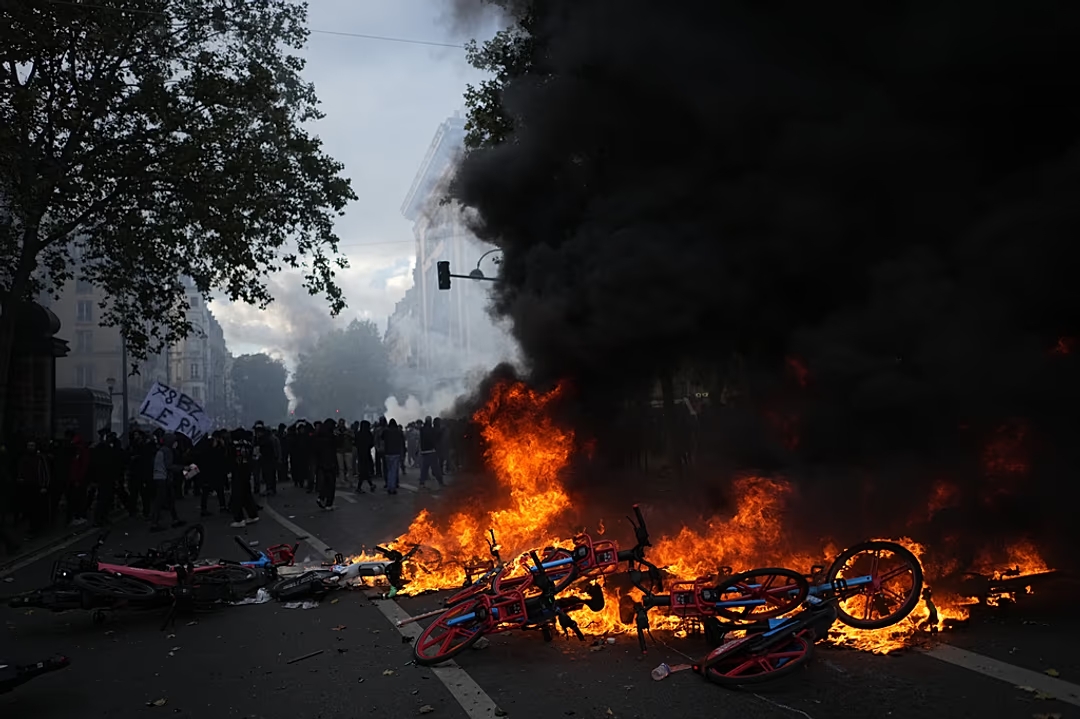
Violent protests across France over deteriorating school facilities, rising living costs and public services have triggered an international debate over immigration, with African immigrants warning against blaming entire communities for the actions of individual demonstrators.
The unrest, which began with student demonstrations in September, has spread nationwide, drawing support from teachers, trade unions and other groups frustrated by economic pressures and government spending policies.
However, the violence has also become a political talking point beyond France, with US President Donald Trump and other political leaders linking the unrest to immigration and calling for tougher border controls.
For Diabagate Adama, an African immigrant who has worked in France’s private security industry for nearly a decade, such claims risk unfairly targeting migrant communities while overlooking the domestic grievances that initially brought protesters onto the streets.
“To say it’s immigration is to attack an entire community,” Adama said, rejecting suggestions that immigration was responsible for the disorder.
Protests Over Education and Living Costs Escalate
The demonstrations began in September as students protested deteriorating school buildings, teacher shortages and other challenges affecting the French education system.
The movement subsequently expanded as teachers, trade unions and other sections of society joined calls for action over the rising cost of living and government spending plans.
By Saturday, October 17, more than 550,000 people had reportedly participated in demonstrations across France, according to official estimates cited in media reports.
Although many demonstrations remained peaceful, some descended into violence, with reports of damaged businesses, looting, clashes with police and attacks on public buildings.
The unrest has placed additional pressure on President Emmanuel Macron’s government, which is already confronting political divisions, mounting public debt and disputes over public spending.
The scale of the demonstrations has also raised questions about the government’s ability to address public dissatisfaction while restoring order and protecting businesses.
African Immigrant Rejects Immigration Blame
Adama, who has managed security operations in Paris since 2017, said he was surprised by the scale of destruction during the latest demonstrations.
“This time, I think the crisis has been extremely violent,” he told Africanews, recalling previous periods of unrest, including the Yellow Vest protests and disturbances surrounding major football matches.
He said the destruction of public buildings and symbols of the French state had made the latest unrest particularly concerning.
Adama also suggested that some businesses were inadequately prepared for the scale of the violence, arguing that security arrangements were not sufficiently strengthened because few anticipated such widespread destruction.
However, he strongly rejected attempts to attribute the unrest to immigration.
“You cannot necessarily say that immigration is responsible for this disorder,” he said.
He noted that the student movement involved people from different racial, ethnic and social backgrounds, making it misleading to single out one community as responsible for the violence.
“Among the students, there are people of all races and all communities,” Adama added.
His remarks highlight concerns that political narratives linking immigration to public disorder could stigmatise entire communities without establishing who was responsible for specific acts of violence.
Economic Consequences Worry Migrant Workers
Despite the increasingly heated political debate, Adama said he did not personally feel threatened as an African immigrant living in France.
Instead, his principal concern is the economic impact of the unrest on businesses and workers.
“We don’t feel threatened. The only problem is that it reduces business activity,” he said.
Adama’s work involves supplying security personnel to shops and other commercial premises. When businesses are damaged, forced to close or require extensive repairs, security companies can lose contracts and employees may experience disruptions to their income.
He explained that some affected establishments could take weeks or even months to reopen, creating uncertainty for security providers and their workers.
“That’s where we lose out,” he said.
The disruption also presents challenges for companies whose employees retain contractual rights even when circumstances beyond their control prevent them from carrying out their duties.
For workers in the private security sector, the protests therefore represent not only a public safety concern but also a potential threat to employment stability and business revenue.
Immigration Debate Gains International Attention
The unrest has attracted international political attention, with Trump describing France as “burning” and blaming immigration for what he characterised as the country’s decline.
US Vice-President JD Vance and Hungarian Prime Minister Péter Magyar have also linked the violence to migration, using the situation to support calls for stricter border policies.
Their comments have helped transform a crisis that began with domestic grievances into part of a wider international debate about immigration, national identity and public security.
France has longstanding historical, cultural and economic ties with African countries, shaped by colonial history, migration, trade and family connections.
Communities with roots in Algeria, Morocco, Tunisia, Senegal, Mali and Côte d’Ivoire, among other countries, are part of French society. Their experiences, citizenship and immigration statuses vary considerably.
However, critics of broad anti-immigration rhetoric argue that linking unrest to migration without evidence of individual responsibility risks blurring important distinctions between lawful residents, citizens of immigrant backgrounds and those involved in criminal acts.
The debate has particular significance for African communities in France, whose contributions to the country’s economy and social life often become entangled in broader political arguments over migration.
France Faces Political Pressure Ahead of 2027 Election
The unrest comes as France approaches its 2027 presidential election, with immigration, national identity and public security already prominent political issues.
Marine Le Pen’s far-right National Rally has long advocated stricter immigration controls and is seeking to strengthen its political influence.
The latest protests could further intensify political disagreements over how France should respond to public disorder, economic hardship and migration.
However, the initial demands of demonstrators centred on education, living costs and public services, raising questions about whether immigration-focused political responses adequately address the causes of the unrest.
The French government faces the challenge of restoring public order while responding to the economic and social concerns that mobilised hundreds of thousands of people.
A Crisis Extending Beyond Immigration
For Adama and other workers affected by the unrest, the immediate consequences are measured in damaged businesses, interrupted contracts and uncertainty about future earnings.
While politicians debate immigration and border security, the underlying grievances over education, living standards and public services remain central to understanding why the demonstrations began.
The situation has renewed questions about how governments should distinguish between legitimate public grievances, criminal acts committed during protests and broader debates about migration.
For African immigrants living and working in France, the concern is that the actions of some individuals could be used to cast suspicion on entire communities.
As France seeks to restore calm, the debate continues over how to address violence and economic dissatisfaction without turning a domestic crisis into a wider confrontation over who belongs in French society.

