

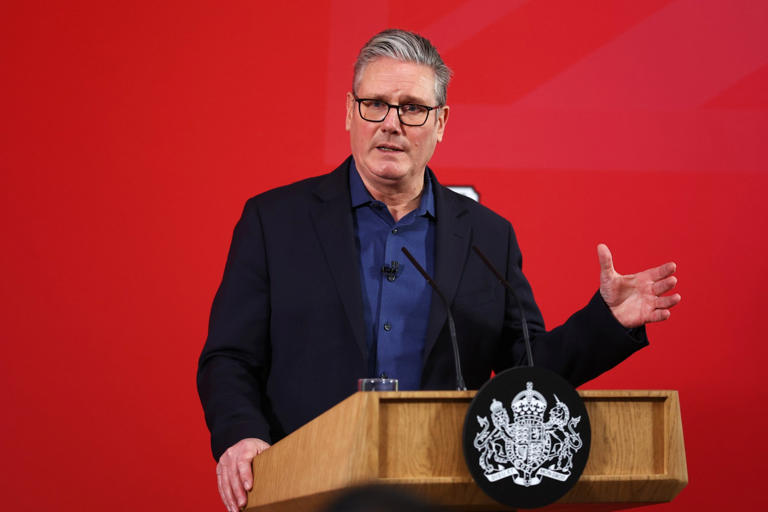
British Prime Minister Keir Starmer announced his resignation on Monday, bowing out after less than two years in office following months of mounting political pressure, policy reversals and declining public support.
In an emotional address outside 10 Downing Street, Starmer said he would step down as leader of the Labour Party but remain prime minister until a successor is chosen, with the leadership contest expected to begin in July and conclude before Parliament returns from its summer recess in September.
“Every decision I have taken has been about putting the country I love first. That is why I will resign as leader of the Labour Party,” Starmer said, appearing visibly emotional during the announcement.
The resignation marks another dramatic turn in British politics and sets the stage for the country to have its seventh prime minister in a decade, underlining the continuing instability that has shaped the post-Brexit era.
Starmer had until recently insisted he would remain in office despite intensifying calls for his departure. But his premiership had come under sustained strain from a series of political setbacks, including criticism over welfare cuts, controversy surrounding defence spending plans and internal party unrest triggered by scandals and high-profile resignations.
His position was further weakened by Labour’s poor performance in recent local elections, where the party lost ground to the far-right, anti-immigration Reform UK movement, highlighting growing dissatisfaction among voters.
Starmer, who led Labour back to power in 2024 after 14 years of Conservative rule, had initially been credited with rebuilding the centre-left party into an election-winning force. However, that momentum faded as his government struggled to maintain public confidence and political discipline.
One of the most damaging episodes of his tenure came in March, when he faced fierce criticism over the appointment of Peter Mandelson as Britain’s ambassador to Washington. The decision drew backlash because of Mandelson’s reported association with late convicted sex offender Jeffrey Epstein, further fuelling discontent within Labour ranks.
Attention is now turning to the race to replace Starmer, with veteran politician Andy Burnham emerging as a leading contender. Burnham is set to be sworn in as a member of parliament on Monday after winning a crucial special election last week, a victory that clears the way for him to formally enter the Labour leadership contest.
Starmer said he would work to ensure a smooth transition of power and pledged full support to whoever succeeds him.
“I will remain in post as prime minister until the contest is complete, and I will do everything I can to ensure an orderly handover of power,” he said.
The resignation comes a day before the 10th anniversary of the Brexit referendum, a political watershed that triggered Britain’s departure from the European Union and ushered in years of turbulence at the top of government.