

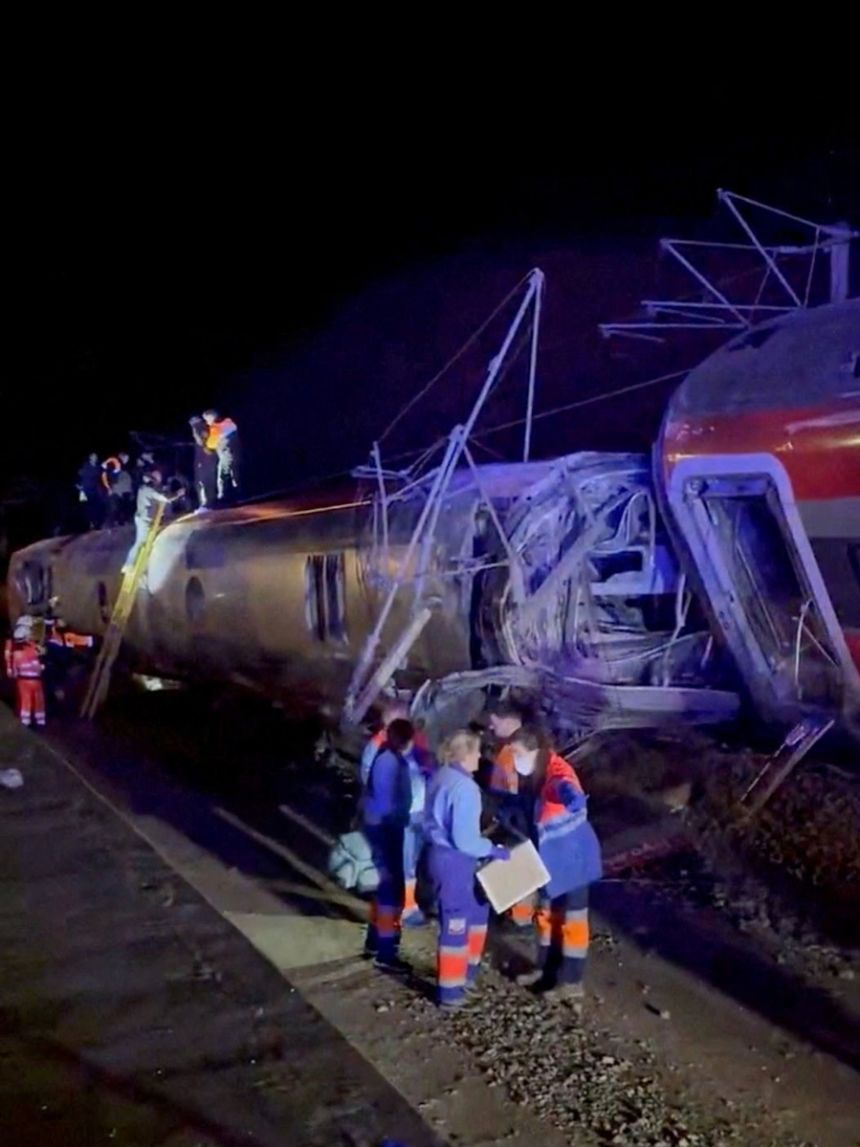
Spanish authorities say at least 39 people have been confirmed dead following a catastrophic collision involving two high-speed trains in southern Spain, one of the deadliest rail disasters in the country in decades.
Police and emergency officials said the crash occurred Sunday evening at about 7:45 p.m. when the rear section of a train traveling from Malaga to Madrid derailed, striking another high-speed train coming in the opposite direction from Madrid to Huelva. The impact hurled the leading carriages of the second train off the tracks and down a four-meter embankment.
Andalusia’s regional president Juanma Moreno described the scene near the town of Adamuz as “a mass of twisted metal,” warning that the death toll could rise as rescue teams continued to search the wreckage.
“The impact was so violent that bodies have been found hundreds of meters from the crash site,” Moreno said.
Rescue and identification efforts continue
Authorities said all survivors were rescued by early Monday morning, but recovery operations were still underway. Family members of passengers have been asked to provide DNA samples to assist with identifying victims, as some bodies remain trapped inside damaged carriages.
Regional emergency services reported that 43 people remain hospitalized, including 12 in intensive care, while at least 79 others were treated and discharged.
The crash involved a train operated by private company Iryo, carrying 289 passengers, and a second train run by state-owned rail operator Renfe, which was transporting nearly 200 passengers, according to infrastructure manager Adif.
Transport Minister Óscar Puente said the front two carriages of the second train absorbed the force of the collision and appeared to account for most of the fatalities.
Nation in mourning
Prime Minister Pedro Sánchez declared three days of national mourning, calling the disaster “a day of pain for all of Spain.” He traveled to Adamuz on Monday to meet with victims’ families and emergency responders.
“This tragedy has shaken the entire country,” Sánchez said, praising local residents who assisted injured passengers in the immediate aftermath.
Spain’s flag was flown at half-staff outside Parliament in Madrid, while condolences poured in from across Europe and beyond. Pope Leo XIV expressed sympathy for the victims, and European Commission President Ursula von der Leyen said she was following the “terrible news” closely. King Felipe VI also offered condolences and said the royal household was considering a visit to the affected area.
Cause under investigation
Officials said the cause of the derailment remains unclear. Puente described the incident as “truly strange,” noting that the section of track was flat and had been renovated in May, and that the derailed train was less than four years old.
Renfe president Álvaro Fernández said both trains were traveling well below the 250 kph speed limit and suggested that human error could likely be ruled out. He said the investigation would focus on infrastructure or rolling stock issues.
Iryo confirmed that the derailed train was manufactured in 2022 and had passed a safety inspection on January 15.
Rare tragedy on a flagship network
Spain boasts Europe’s largest high-speed rail network, with more than 3,900 kilometers of track and a reputation for safety and efficiency. Sunday’s crash marks the first fatal accident on Spain’s high-speed rail system since its launch in 1992.
Rail services between Madrid and several Andalusian cities were suspended on Monday, forcing thousands of passengers to seek alternatives. Airline Iberia added extra flights to Malaga and Seville, while bus operators increased capacity in the region.
As investigations continue, Spain faces difficult questions about how such a disaster could occur on one of Europe’s most advanced rail networks.