
Iran and the United States intensified military signaling on Thursday as fragile nuclear negotiations appeared to stall, with Tehran conducting joint naval drills with Russia while Washington moved another aircraft carrier closer to the Middle East.
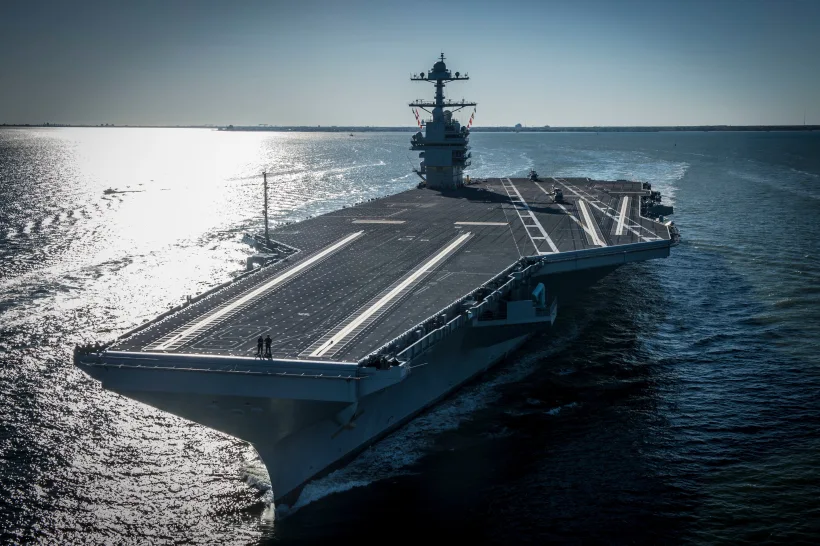
The parallel displays of force highlighted deepening tensions between Iran and the United States, even as diplomatic channels remain open. Iranian state media confirmed that Tehran was holding maritime exercises with Russia, while U.S. tracking data showed the aircraft carrier USS Gerald R. Ford moving toward the eastern Mediterranean.
Earlier this week, Iran also launched separate live-fire drills in the Strait of Hormuz, a strategic chokepoint through which roughly one-fifth of the world’s traded oil passes. Tehran issued rocket-fire warnings to pilots in the region, signaling possible anti-ship missile tests as part of the exercises.
While the movement of U.S. warships and aircraft does not guarantee an imminent strike, it provides Washington with expanded military options. President Donald Trump has so far refrained from direct military action against Iran, despite previously setting red lines over Tehran’s violent crackdown on protests and mass executions. At the same time, his administration has sought to revive nuclear negotiations disrupted by the Iran-Israel conflict in June.
In a statement posted on his Truth Social platform, Trump warned that failure to reach a deal could lead the United States to use overseas bases, including Diego Garcia and an airfield in Fairford, to counter what he described as threats from an “unstable and dangerous regime.” The remarks were also aimed at pressuring the United Kingdom over negotiations with Mauritius concerning the Chagos Islands.
The Iranian-Russian drill took place in the Gulf of Oman and the Indian Ocean, according to Iran’s state-run IRNA news agency. The exercise was intended to enhance operational coordination and exchange military experience between the two forces. China, which has participated in similar “Security Belt” drills in previous years, was not reported to be involved this time. In recent days, a Russian Steregushchiy-class corvette was spotted at a military port in Bandar Abbas, underscoring Moscow’s presence in the region.
Meanwhile, the Ford carrier was last tracked off the coast of Morocco, positioning it to transit through Gibraltar and potentially deploy in the eastern Mediterranean. U.S. officials say such a deployment would bolster airpower and missile defense capabilities to protect regional allies, including Israel and Jordan, in the event of a wider conflict. Similar naval posturing was used during the Israel-Hamas war in Gaza.
Beyond the military maneuvers, Iran continues to grapple with domestic unrest following its crackdown on protests sparked by economic grievances and political dissent. Mourning ceremonies marking 40 days since the deaths of demonstrators have spread across the country, including gatherings at Tehran’s Behesht-e Zahra cemetery. Witnesses and social media footage show some mourners chanting anti-government slogans and singing nationalistic songs, despite warnings from authorities.
The protests began late December at Tehran’s Grand Bazaar over the collapse of the national currency, the rial, before spreading nationwide. Tensions escalated further in early January after calls for demonstrations by exiled crown prince Reza Pahlavi.
Iranian authorities have acknowledged 3,117 deaths linked to the unrest. However, the U.S.-based Human Rights Activists News Agency estimates the toll at more than 7,000, with many additional casualties feared unreported.
As military pressure mounts and internal dissent simmers, the future of Iran-U.S. nuclear talks remains uncertain, raising concerns of further escalation in an already volatile region.