

Ghanaians across social and political spaces are raising strong objections to recent claims that Fulani communities should be classified as indigenous to Ghana, following renewed public debate and controversial statements linked to political campaigns and regional security tensions.
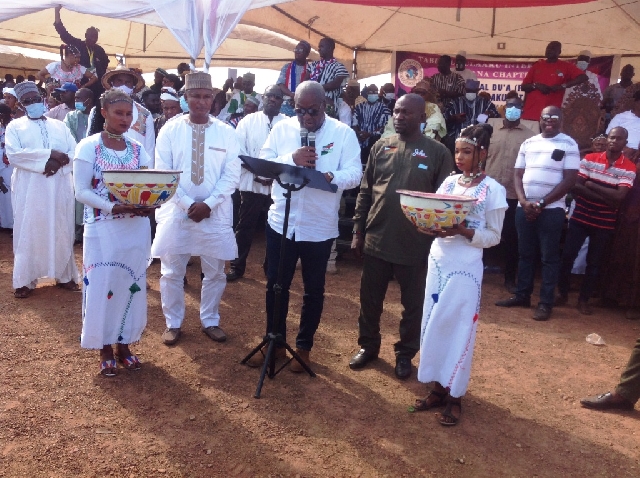
The debate intensified after sections of the Fulani community in Ghana reportedly cited comments made by former President John Dramani Mahama during the 2024 general election campaign. At a meeting with Fulani representatives, Mahama was quoted as saying that any group present in Ghana before independence could qualify as Ghanaian. Critics argue that this remark has since been used as the basis for demands and, more controversially, threats referencing instability in neighboring countries such as Burkina Faso, Mali, and Nigeria.
Many Ghanaians insist that the concept of indigeneity in Ghana is rooted not merely in residency timelines but in clearly traceable ancestral homelands, traditional authority systems, and pre-colonial land demarcations. They argue that Ghana’s formation was built on established ethnic groups with defined territories long before independence in 1957.
Social activist Yaw Boadi has emerged as one of the prominent voices in the debate. He contends that tribes such as the Ashanti, Ewe, Anlo, Dagbon, Wala, Akwamu, Guan, Ahanta, and others can all trace their ancestral origins to specific lands within present-day Ghana.
“Which part of Ghana’s land, town, or city is the ancestral homeland of the Fulani?” Boadi asked, questioning the basis of indigenous claims by a historically nomadic group. He emphasized that while Fulani communities are free to live and work in Ghana, their status should remain that of residents, not indigenes, unless they can demonstrate ancestral settlement comparable to other ethnic groups.
Boadi further warned against what he described as veiled threats invoking violence or instability seen in parts of the Sahel and West Africa. “Ghana is not a country to joke with, and it is not like the countries being referenced in these threats,” he said, stressing that national laws, traditions, and chieftaincy systems must be respected.
The activist also cautioned politicians against making what he called “reckless statements” for electoral advantage. According to him, Ghana’s Constitution was crafted to coexist with long-standing traditions and ancestral land rights. Any attempt to redefine indigeneity, he argued, risks undermining the very foundations laid by Ghana’s forefathers.
“The Constitution came to meet our traditions, not to erase them,” Boadi said, adding that leaders who advocate such changes should be prepared to surrender their own ancestral lands if they truly believe residency alone confers indigene status.
The controversy unfolds amid heightened regional insecurity linked to terrorism, banditry, and ethnic tensions in parts of West Africa, making the debate particularly sensitive. Analysts warn that while Ghana has long been praised for its peaceful coexistence among diverse groups, inflammatory rhetoric whether political or communal could strain social cohesion if not carefully managed.
As discussions continue, many observers are calling for calm, clear constitutional interpretation, and responsible political leadership to prevent the issue from escalating into ethnic or security-related conflict.