

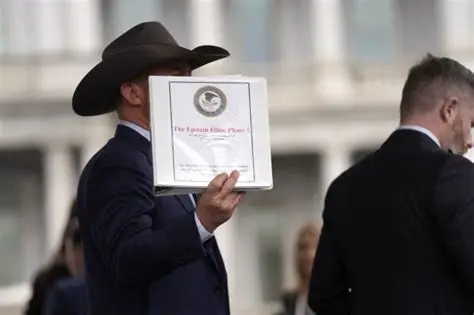
The U.S. Department of Justice has released thousands of files related to convicted sex offender Jeffrey Epstein, but the long-anticipated document dump has delivered few new revelations about the financier’s criminal investigations or his connections to powerful figures.
The files, made public on Friday under a congressionally mandated deadline, consist largely of photographs, alongside call logs, interview transcripts, grand jury materials and other records. Many of the documents are heavily redacted, and several had already circulated in the public domain, dampening expectations that the release would significantly advance public understanding of Epstein’s network or the government’s handling of the case.
Among the most notable materials are photographs of high-profile figures who associated with Epstein before his criminal conduct became widely known. Former U.S. President Bill Clinton appears prominently in several images, including photographs taken aboard private planes and at Epstein-linked properties. Clinton has long acknowledged flying on Epstein’s jet but has denied any knowledge of, or involvement in, Epstein’s crimes.
By contrast, President Donald Trump is scarcely featured in the released files, appearing only in a handful of well-known photographs from the early 2000s, including images with Epstein and Melania Trump at events held at Mar-a-Lago. The limited references spared the White House renewed scrutiny over a relationship Trump has sought to downplay, emphasizing that he severed ties with Epstein years before the financier’s arrest.
The Justice Department acknowledged that the release is incomplete. In a letter to Congress, Deputy Attorney General Todd Blanche said the department is continuing to review additional records, with some documents withheld under exemptions designed to protect victims. Further disclosures are expected later this year, he said.
The release follows months of political pressure. Although the Trump administration had previously indicated no further Epstein records would be made public, Congress passed legislation compelling disclosure. Trump ultimately signed the bill, setting a 30-day deadline that expired Friday.
Lawmakers from both parties criticized the scope of the release, arguing that it failed to meet the spirit of the transparency law. At the same time, White House officials highlighted images of Clinton included in the files, fueling partisan exchanges on social media.
Legal experts note that the presence of names or photographs in investigative files does not imply wrongdoing. Neither Trump nor Clinton has ever been charged in connection with Epstein.
The documents also shed limited light on the early handling of allegations against Epstein. One newly highlighted record references a 1996 complaint to the FBI involving concerns about inappropriate photographs of minors, though it remains unclear what action, if any, was taken at the time.
Epstein’s case has spanned nearly two decades, involving multiple investigations, a controversial 2008 plea deal that allowed him to avoid federal prosecution, and renewed charges in 2019. He died in federal custody later that year. His longtime associate, Ghislaine Maxwell, was convicted in 2021 of recruiting underage girls for abuse and is serving a 20-year prison sentence.
Victims’ advocates say the latest release underscores the need for fuller transparency.
“Just put out the files,” said Marina Lacerda, one of Epstein’s accusers. “And stop redacting names that don’t need to be redacted.”
As the Justice Department continues its review, public attention remains fixed on whether future disclosures will answer lingering questions about how Epstein was able to operate for years and whether accountability will ever extend beyond those already convicted.