

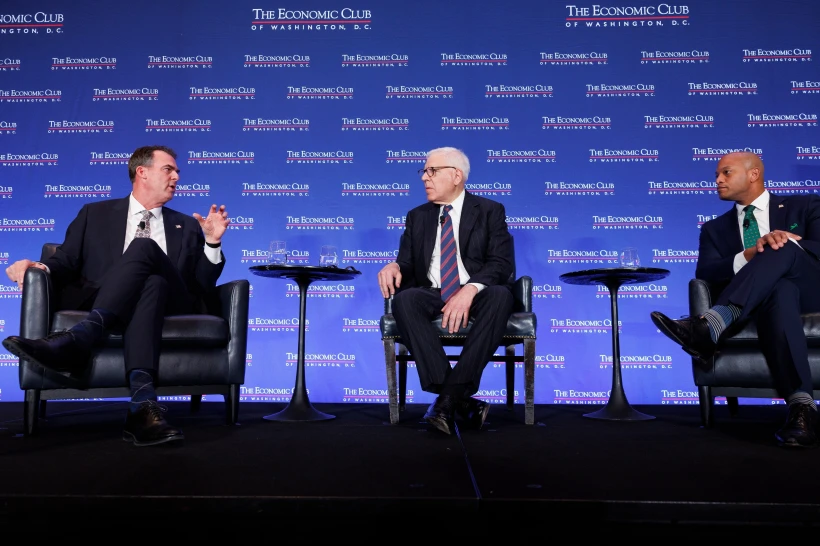
In an increasingly polarized political climate under President Donald Trump, a rare display of bipartisan civility unfolded this week as governors from opposing parties shared a stage in Washington.
Oklahoma Governor Kevin Stitt, a Republican, and Maryland Governor Wes Moore, a Democrat, appeared side by side, exchanging jokes and compliments rather than the sharp rhetoric that has come to define national politics. The moment offered a brief pause from the broader atmosphere of political conflict dominating the U.S. capital.
Stitt and Moore currently serve as chair and vice chair of the National Governors Association (NGA), one of the few remaining bipartisan institutions in American governance. However, the group’s traditional role as a refuge from partisan division is being tested as it holds its annual conference this week.
Breaking long-standing custom, President Trump declined to invite all governors to the traditional White House meeting and dinner typically held during the NGA gathering. Trump has publicly criticized Stitt, labeling him a “RINO” Republican in name only and has continued his feud with Moore, blaming the Maryland governor for a sewage spill linked to a federally regulated pipeline.
The episode reflects a broader pattern in Trump’s second term, marked by confrontations with state governments. The administration has at times withheld federal funding or deployed troops over the objections of local officials, intensifying tensions between Washington and the states.
With a Republican-controlled Congress showing little appetite to curb executive power, several governors have increasingly positioned themselves as a counterweight to the White House.
“Presidents aren’t supposed to do this stuff,” said Utah Governor Spencer Cox, referring to the expansion of executive authority in recent administrations. “Congress needs to get their act together. And stop performing for TikTok and actually start doing stuff.”
Cox argued that “it is up to the states to hold the line,” a view echoed by Moore, who said governors are uniquely positioned to respond to the current political moment.
“People are paying attention to how governors are moving, because I think governors have a unique way to move in this moment that other people just don’t,” Moore said in an interview.
Despite tensions surrounding White House invitations with Trump reportedly saying Moore and Colorado Governor Jared Polis were “not worthy” of attending governors struck an optimistic tone as the conference opened.
“This is bigger than one dinner at the White House,” Stitt said, predicting productive discussions. Moore agreed, saying the gathering would be “a very productive three days for the governors.”
Sitting together, Stitt emphasized the value of bipartisan dialogue. “Here’s a Republican and Democrat governor from different states that literally agree on probably 80% of the things,” he said. “And the things we disagree on we can have honest conversations on.”
Whether that cooperative spirit can endure amid mounting political pressure remains uncertain. Still, Stitt said disagreement is not only inevitable but necessary. “We can have disagreements. In business, I always want people around me arguing with me and pushing me because that’s where the best ideas come from,” he said. “We need to all have these exchange of ideas.”