

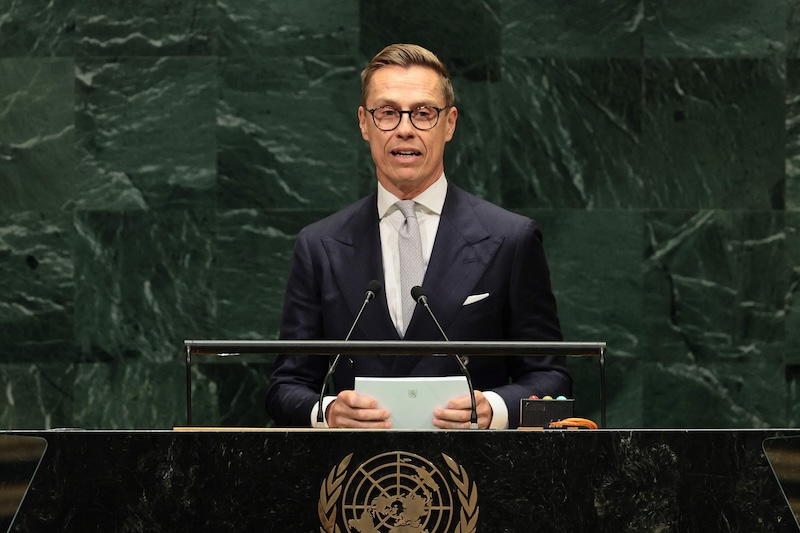
Finnish President Alexander Stubb has called on world leaders to reaffirm their commitment to international law and proposed sweeping reforms to the United Nations Security Council as Finland campaigns for a non-permanent seat on the council for 2029–2030.
Addressing the 81st United Nations General Assembly in New York on Tuesday, Stubb framed the international system’s current challenges as a choice between cooperation and conflict.
“Foreign policy is about a choice. Cooperation or conflict,” Stubb told delegates.
The Finnish president warned that growing distrust between states, disregard for international rules and weakening international institutions were putting the global system under increasing pressure.
He acknowledged that competition between countries was inevitable but argued that governments should not abandon the rules and principles governing international relations.
Stubb Calls for Security Council Reform
Stubb outlined three areas he said should guide international action: respect for international law, adherence to humanitarian principles and greater restraint in political rhetoric.
He also used his address to present Finland’s proposals for reforming the UN Security Council.
Under his proposal, the council would gain at least two additional seats for Africa, two for Asia and one for Latin America.
Stubb also called for an end to the veto power held by the council’s permanent members and proposed temporarily suspending the voting rights of Security Council members that violate the UN Charter.
Finland is seeking election to a non-permanent seat for the 2029–2030 term as Helsinki seeks a greater role in international diplomacy.
“We are ready to carry the responsibility that comes with Security Council membership at a time when the world needs more peace,” Stubb said.
Proposal for a “New San Francisco Moment”
Stubb concluded his address by proposing what he called a “new San Francisco moment,” referring to the 1945 conference that resulted in the creation of the United Nations Charter.
He suggested that the next UN secretary-general should lead a process bringing governments together to renew their commitment to the principles underpinning the international system.
The Finnish president also argued that smaller and flexible coalitions of countries could play a role when consensus among all UN members becomes difficult.
Such arrangements, he said, should strengthen rather than replace the broader UN system.
Gaza, Sudan and Haiti Highlighted
Stubb also addressed several ongoing humanitarian crises, including Gaza, Sudan and Haiti.
He described the situation in Gaza as one of the world’s most serious humanitarian crises, pointing to widespread displacement, destruction of infrastructure and shortages of basic services.
He called for greater resources to be directed toward conflict prevention and the protection of human rights.
His emphasis on international law came as the General Assembly was dominated by disputes over military action and the effectiveness of international institutions.
UN Secretary-General António Guterres said the destruction and loss of life in Gaza had reached a scale he had not witnessed during his time leading the organisation.
Guterres also warned that Israeli settlement expansion and displacement in the occupied West Bank were undermining prospects for a two-state solution.
Turkish President Recep Tayyip Erdogan condemned Israel’s actions in Gaza and called for increased international pressure, while Jordan’s King Abdullah II accused the international community of failing to enforce international law in the Palestinian territories.
Ukraine and Iran Remain Central Issues
The war in Ukraine was another major issue during the General Assembly.
Guterres described Russia’s invasion as a violation of the UN Charter, while U.S. President Donald Trump met Ukrainian President Volodymyr Zelenskyy on the sidelines of the gathering and said the two were working toward ending the conflict.
Trump also used his General Assembly address to threaten further action against Iran while saying he expected an agreement with Tehran after the U.S. midterm elections in November.
Trump described the choice facing Iran as an agreement or what he called the “annihilation” of the country. He later said U.S. officials had held a three-hour meeting with an Iranian delegation on Tuesday.
Trump also called on UN members to withdraw from the International Criminal Court, saying the United States would not allow the court to investigate American personnel.
Finland Also Pushes for AI Governance
Stubb’s speech also addressed the growing challenge posed by artificial intelligence.
He said Finland and Norway had joined other countries in supporting mechanisms to govern advanced AI models.
AI governance is expected to form part of Finland’s diplomatic programme during the UN General Assembly’s high-level week.
Stubb ended his address by invoking former UN Secretary-General Kofi Annan, saying that despite differences between countries, the international community ultimately shares a common fate.
“Whatever our differences, we will either succeed or fail together,” Stubb said.