

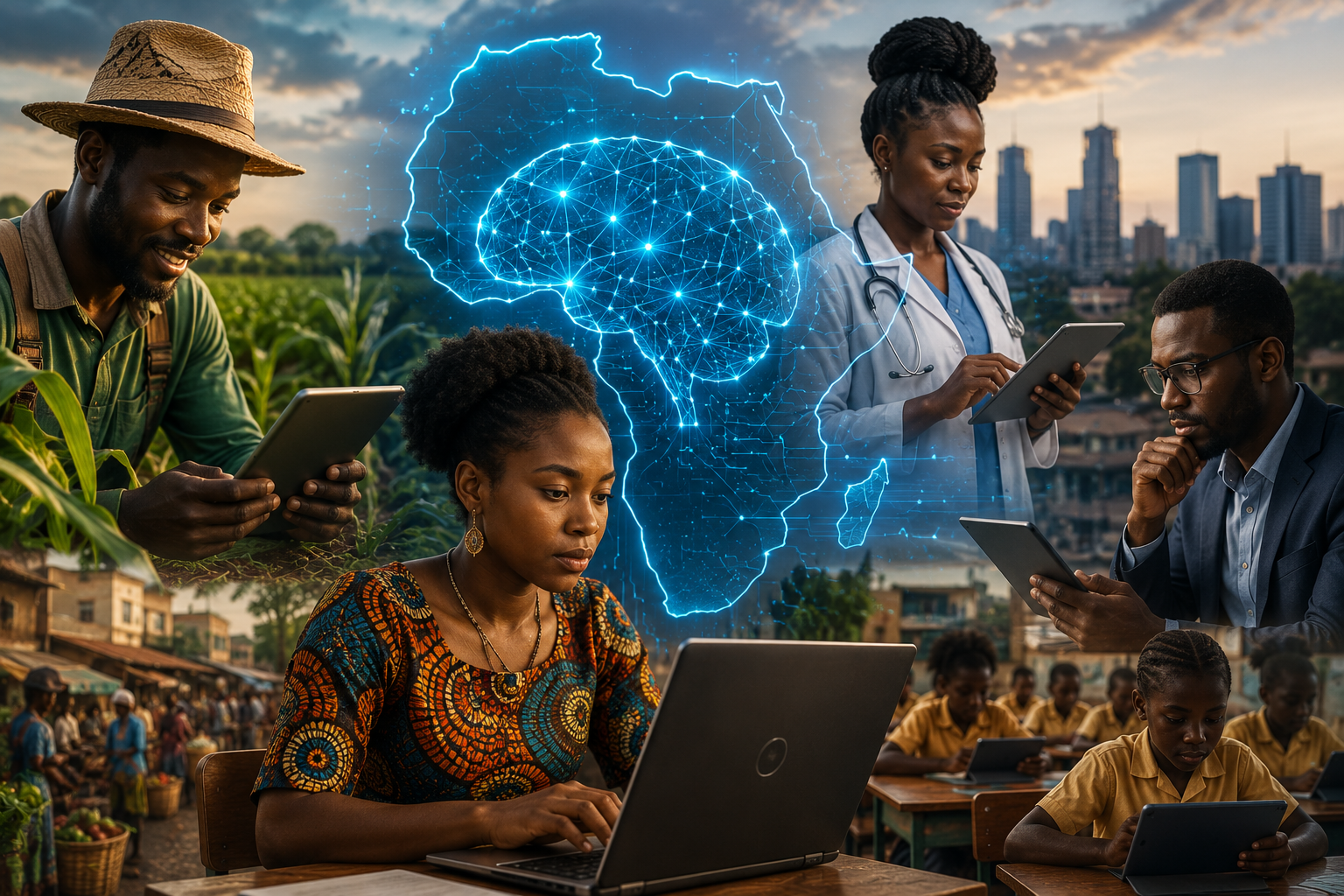
Artificial intelligence is rapidly becoming one of the world’s most important technologies, but for Africa, the next stage of the AI revolution may need to go far beyond chatbots, content generation and virtual assistants.
The bigger opportunity is to develop AI systems designed to solve real African problems from agriculture and education to healthcare, financial inclusion, logistics, public services and the challenges faced by small businesses.
As the global AI industry expands, African innovators are increasingly asking a different question: What can AI do for communities whose realities are not always represented in the data used to build today’s leading systems?
From Conversation to Problem-Solving
Chatbots have demonstrated how accessible artificial intelligence can become. People can ask questions, summarize documents, generate content, translate information and perform a growing number of everyday tasks through conversational interfaces.
But Africa’s needs extend much further.
An AI system designed for African markets could help farmers analyze crop conditions, assist businesses with financial and operational decisions, support teachers with localized educational materials, help organizations manage large amounts of information and make digital services more accessible to people who have traditionally been excluded from advanced technology.
The objective is to move from AI that simply answers questions to AI that can understand problems and help people act on them.
Dipa AI and the African Opportunity
This broader vision provides the context for Dipa AI, an emerging concept within Amineva’s technology vision focused on exploring how artificial intelligence can become more relevant to African users and businesses.
Rather than viewing AI simply as another chatbot, the Dipa AI vision points toward a future in which intelligent systems can be integrated into practical services and workflows.
The opportunity is particularly important because Africa is not a single market. The continent contains diverse languages, cultures, industries, regulatory environments and economic conditions.
AI developed for African users therefore needs to account for those differences rather than assuming that solutions created for other markets will automatically work everywhere.
AI for Agriculture and Small Businesses
Agriculture offers one of the clearest opportunities.
AI could eventually help farmers interpret weather information, identify crop diseases, improve production decisions and access market information. When combined with mobile technology and local knowledge, such systems could potentially bring advanced analytical capabilities to communities that have historically had limited access to them.
Small and medium-sized businesses could also benefit.
AI tools could help entrepreneurs manage inventory, analyze sales, prepare documents, communicate with customers, monitor expenses and make better-informed business decisions.
For many African businesses operating with limited staff and resources, practical automation could have a more immediate economic impact than sophisticated consumer-facing AI applications.
Education and Local Knowledge
Education is another area where African-focused AI could make a significant difference.
AI systems capable of working with local curricula and African languages could support teachers and students with learning materials, tutoring and research assistance.
The challenge, however, is ensuring that these systems understand local contexts and do not simply reproduce information created for completely different educational environments.
The same principle applies to African history, culture and indigenous knowledge.
If African information is poorly represented in AI systems, future generations could increasingly interact with technologies that know more about distant societies than about their own communities.
Healthcare, Public Services and Financial Inclusion
The potential applications also extend to healthcare and public administration.
AI could assist health workers with information management, help organizations analyze large datasets and make public services easier to navigate.
In financial services, intelligent systems could support small businesses and individuals with financial planning, fraud detection, customer service and access to relevant information.
Such applications require strong safeguards, particularly where AI is involved in decisions affecting people’s health, finances, employment or access to public services.
Building Rather Than Just Consuming
Perhaps the most important question for Africa is whether the continent will remain primarily a consumer of artificial intelligence or become a significant contributor to its development.
Building locally relevant AI requires investment in computing infrastructure, research, data, universities, technical training and African technology companies.
It also requires developers to collect and use data responsibly while protecting privacy and ensuring that AI systems do not reproduce existing inequalities.
The continent’s young population and expanding technology ecosystem provide an important foundation. But turning that potential into globally competitive AI will require sustained investment rather than short-term enthusiasm.
The Next Generation of African AI
The future of AI in Africa may ultimately not be defined by who builds the biggest chatbot.
It could be defined by who builds the most useful systems for the continent’s everyday challenges.
From a farmer seeking better information about a crop to an entrepreneur trying to manage a growing business, from a student looking for localized educational support to an institution processing thousands of documents, the real value of AI will increasingly be measured by the problems it can help solve.
That is the opportunity behind the emerging vision for Dipa AI: to explore artificial intelligence not merely as a conversational technology, but as a platform for building practical solutions around African realities.
Africa does not need to wait for the rest of the world to define its AI future.
The continent can build the intelligence, tools and applications that address its own problems and in doing so, help shape the global future of artificial intelligence.