

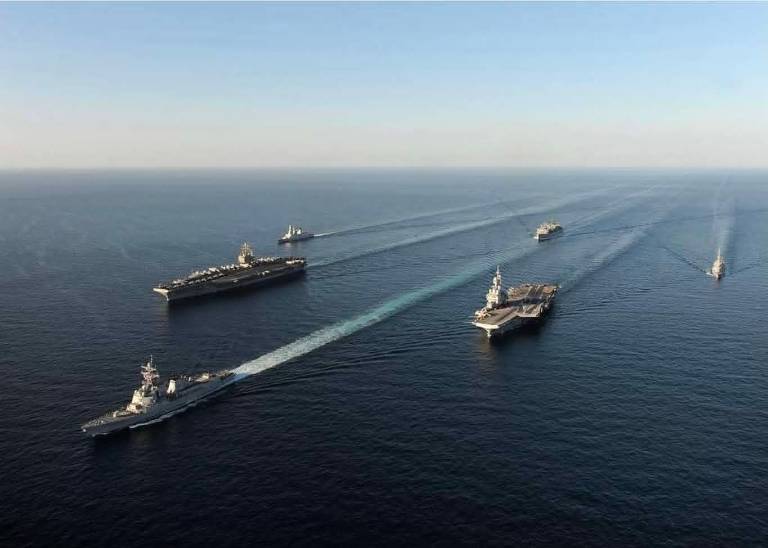
The United States has significantly expanded its naval and air posture near Iran, positioning forces within direct strike range as tensions continue to rise amid unrest inside the Islamic Republic and growing regional uncertainty.
The USS Abraham Lincoln Carrier Strike Group has moved into the eastern Arabian Sea and is preparing to enter the Gulf of Oman, placing U.S. naval airpower closer to Iranian territory. Military assessments indicate that carrier-based F-35C Lightning II and F/A-18E/F Super Hornet aircraft, supported by aerial refueling, are capable of reaching deep inside Iran, including sites linked to missile and nuclear programs.
Defense analysts estimate the carrier group is operating roughly 600 to 1,600 miles from Tehran.
Expanded U.S. naval footprint
The broader U.S. naval posture under U.S. Central Command and U.S. European Command includes multiple Tomahawk-capable destroyers USS Mitscher, USS McFaul, USS Oscar Austin, USS Roosevelt, USS Bulkeley and USS Paul Ignatius as well as submarines USS South Dakota and USS Georgia.
Combined, the deployed surface ships and submarines are assessed to carry approximately 358 Tomahawk cruise missiles, a figure that could rise to about 454 missiles when the Abraham Lincoln strike group is fully factored in.
The carrier group itself includes escort destroyers USS Frank E. Petersen, USS Spruance and USS Michael Murphy, along with nine embarked aviation squadrons. Additional U.S. vessels operating in the region include USS Mount Whitney, USS Lewis B. Puller, USS Tulsa, USS Canberra and USS Santa Barbara, supported by logistics ships and U.S. Coast Guard cutters tasked with maritime security, command-and-control and sustained presence operations.
Airpower repositioning underway
On land and in the air, the U.S. has deployed two F-35 squadrons, three F-15E squadrons, one F-16 squadron and one A-10 squadron across regional bases. These forces are backed by intelligence, surveillance and refueling platforms including P-8A Poseidon aircraft, MQ-4C Triton drones, C-17A Globemaster transports and KC-135, KC-46A and KC-130J tankers.
Separately, a U.S. Air Force F-15E Strike Eagle departed RAF Lakenheath on Tuesday as part of routine CORONET movements, supported by a KC-135 Stratotanker. Defense officials assess the sortie as part of continued repositioning tied to Middle East readiness.
Israel extends reserve call-up
In Israel, the government is expected to approve the call-up of up to 280,000 reservists through March 2026, reflecting Israel Defense Forces expectations that large-scale deployments on multiple fronts will continue.
Trump comments and developments inside Iran
U.S. President Donald Trump returned to the White House late Tuesday and again posted online that “help is on the way for the people of Iran,” a message that has drawn sharp reactions given the ongoing crackdown on protests in the country.
Meanwhile, Iran is reported to have carried out what may be its first execution linked directly to the current unrest. The BBC reported that Ali Rahbar, a sports coach from Mashhad, was executed after being detained for 10 days in connection with protest activity. Iranian authorities have not publicly commented on the report.
Regional diplomacy in flux
Diplomatic maneuvering is also intensifying. According to The Wall Street Journal, Washington is considering a full withdrawal of U.S. forces from Syria. Separately, Israel’s public broadcaster reported that Lebanon is facing pressure to enter direct negotiations with Israel on a political and security arrangement.
As U.S. military assets converge near Iran and regional diplomacy shifts, analysts warn that the Middle East is entering a highly volatile phase, with developments on multiple fronts carrying the risk of rapid escalation.